Protocol Version 1

Validation Bundle With Grip Strength

A three-part bundle using grip strength, 5x sit-to-stand, and fatigue survey data to validate whether the Energy Score tracks measured strength, functional output, and symptom burden.

Strength / Reserve

Grip Strength

3 trials per hand

Use the best value from each hand. Record dominant hand, body position, and dynamometer model.

Functional Performance

5x Sit-to-Stand

1 timed set

Use the same chair and instructions each visit. Record total time in seconds.

Lived Burden

Fatigue Survey

1 short questionnaire

Use the same instrument each visit. Convert the survey to a normalized fatigue burden score.

Measurement Steps

Detailed Protocol

  • Collect the Energy Score and the measured bundle on the same day whenever possible.
  • Grip strength: seated if possible, shoulder neutral, elbow near 90 degrees, forearm neutral, wrist in comfortable neutral position.
  • Grip strength: complete three maximal squeezes per hand with 15 to 30 seconds rest between trials.
  • Record the best value from each hand and note which hand is dominant.
  • 5x sit-to-stand: use a standard-height chair, ask the participant to stand up and sit down five times as quickly and safely as possible, ideally with arms folded if safe.
  • Fatigue survey: use the same validated survey at every visit rather than changing instruments between visits.
Visit Setup

Time Of Day And Pre-Test Conditions

  • Try to measure at the same time of day for each visit, ideally within the same 2-hour window.
  • Morning or late morning is usually best because it reduces variability from accumulated daytime exertion.
  • Record whether the participant is fasting, post-meal, acutely ill, sleep-deprived, menstruating, or recovering from unusual exertion.
  • Record caffeine use, pain flare, recent medication changes, and any assistive-device use that might affect performance.
  • If the person has post-exertional worsening, do the fatigue survey before the physical tests.
Consistency matters more than choosing the perfect time. A repeatable routine is more valuable than a theoretically ideal one.
Grip Protocol

How To Measure Grip Strength

  • Use the same dynamometer model at every visit whenever possible.
  • Use the same handle setting at every visit unless hand size makes that impossible.
  • Preferred position: seated, feet flat, back supported, shoulder adducted and neutral, elbow at about 90 degrees, forearm neutral.
  • Ask for one short submaximal practice squeeze before formal testing if the person is unfamiliar with the device.
  • Then perform three maximal efforts per hand, alternating hands if helpful, with 15 to 30 seconds of rest between attempts.
  • Record every trial, but use the best value from the strongest hand for the calculator.
  • Document dominant hand, hand pain, arthritis, neuropathy, tremor, or recent upper-extremity injury.
Recommended Device

Handeful digital grip strength dynamometer

A practical low-cost option for this protocol is the Handeful Grip Strength Tester. It reads in pounds or kilograms, stores multiple users, and is easy to keep consistent across repeat visits.
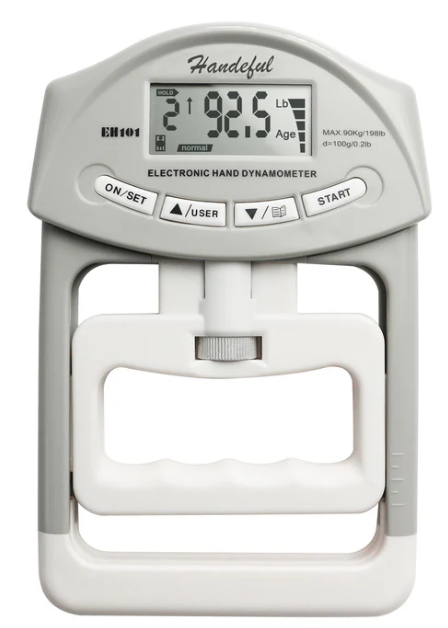
  • Use the same unit setting each visit, ideally pounds if you are using the current calculator inputs.
  • Keep the same handle position for the same participant unless hand size requires a change.
  • Record the device model once so follow-up measurements stay standardized.
Chair Protocol

Exact 5x Sit-to-Stand Setup

  • Use a standard, stable chair without wheels.
  • Preferred seat height is about 43 to 46 cm, which is roughly 17 to 18 inches.
  • Use the same chair for every visit in the same participant whenever possible.
  • Place the chair on a non-slip surface with clear space around it.
  • Standard instruction: sit with back against the chair, feet flat, stand up fully and sit down fully five times as quickly and safely as possible.
  • Preferred method is arms folded across the chest, but if arms are used for safety, record that clearly and keep the method consistent at future visits.
  • Start timing on “go” and stop when the participant stands fully at the end of the fifth repetition.
  • Record the time in seconds and note any abnormal mechanics, hesitation, balance concern, or need for arm assistance.
  • If the participant holds the chair, pushes off repeatedly, or uses steady hand support, record that because the measured-function calculator applies a penalty for assisted completion.
Fatigue Protocol

How To Measure Fatigue

  • Use one fatigue instrument consistently rather than switching surveys between visits.
  • A practical option is the Fatigue Severity Scale if you want something short and familiar.
  • Administer the survey before performance testing if exertion could worsen symptoms the same day.
  • Ask the participant to answer based on their recent usual state, not just how they feel in the last few minutes.
  • Normalize the survey to a 0 to 100 fatigue burden score before comparing it to the measured-function calculator.
  • Record whether the fatigue score reflects a typical day, a flare day, or a recovery day after unusual exertion.
The most important fatigue rule is consistency: same survey, same framing, same scoring conversion.
Frequency

Recommended Visit Schedule

ScenarioCadenceNotes
First validation pilotBaseline, then every 4 weeks for 3 monthsBest default for early signal without overburdening follow-up.
Routine trackingEvery 6 to 8 weeksReasonable when expected changes are slower.
After major intervention changeBaseline, 2 to 4 weeks, then 8 to 12 weeksUseful for separating noise from a sustained response.
Best default: run the full bundle every 4 weeks during the first 12 weeks of validation.
Standardization

How To Reduce Noise

  • Use the same dynamometer model each time.
  • Measure at similar times of day when possible.
  • Note acute illness, recent hard exertion, sleep disruption, or hand pain.
  • Keep the chair height and sit-to-stand instructions constant.
  • Record fatigue before any strenuous testing if post-exertional worsening is a concern.
Minimum Data Capture

What To Record At Every Visit

  • Date and exact time of testing.
  • Sex, age, and any major clinical change since the last visit.
  • Best grip strength by hand and strongest-hand value used for scoring.
  • 5x sit-to-stand time and whether arms were used.
  • Whether chair support was none, light, or moderate during sit-to-stand.
  • Fatigue survey raw score and normalized fatigue burden score.
  • Any acute confounders: illness, flare, poor sleep, unusual exercise, pain, injury, or medication change.